


Introduction to Business Messaging
In today’s competitive digital marketplace, reaching customers at the right time can make a significant difference to business growth. Whether you operate an online store, a retail shop, an educational institute, a service company, or a growing enterprise, effective communication helps you attract new customers and maintain relationships with existing ones.
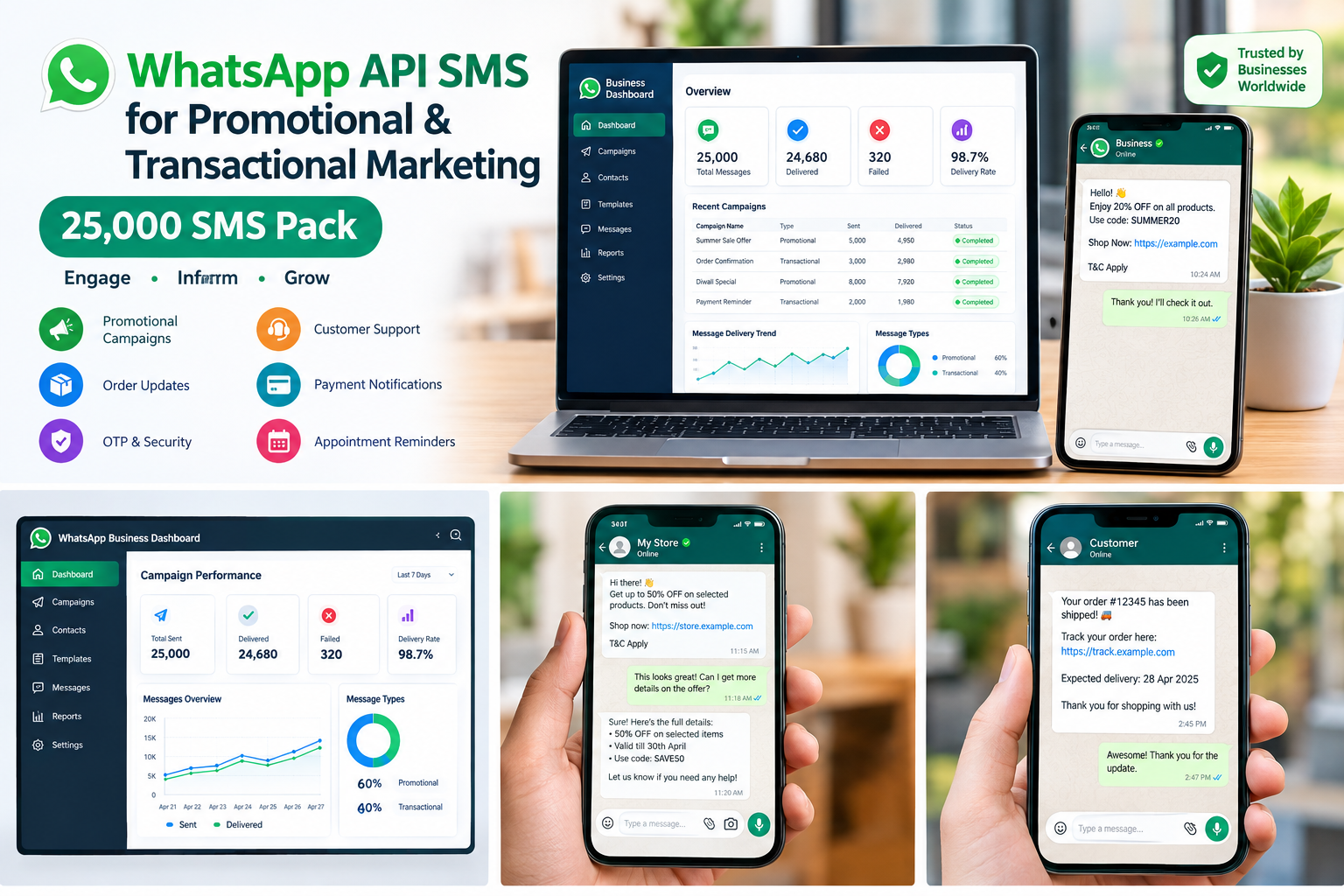
A WhatsApp API SMS for Promotional & Transactional Marketing SMS Pack is a business messaging solution concept designed for companies that want to communicate with customers at scale. It can help businesses plan promotional campaigns, share important updates, and streamline routine customer notifications, depending on the service and messaging channel they purchase. Instead of sending individual messages manually, businesses can use messaging platforms and automation tools to manage campaigns more efficiently.

The important first step is understanding what the package actually includes. Traditional bulk SMS services send text messages through mobile telecom networks, whereas the WhatsApp Business Platform sends messages through WhatsApp using an approved business setup. These are different services, with different pricing structures, technical requirements, and rules.
A package advertised as a “SMS Pack” should clearly state whether it includes traditional SMS messages, WhatsApp messages, or a combination of communication services. Understanding this distinction allows businesses to choose the right package, avoid unexpected expenses, and build a reliable marketing strategy around their communication needs.
What Is WhatsApp Business API?
The WhatsApp Business Platform, commonly referred to as the WhatsApp Business API, is a communication solution that allows businesses to integrate WhatsApp messaging with customer relationship management systems, ecommerce websites, help desks, and marketing automation software. Unlike the standard WhatsApp application, which is primarily designed for individual and small-scale business conversations, the API supports integration with business systems and messaging workflows. Depending on the software provider, businesses can automate order notifications, manage customer enquiries, send approved message templates, and allow multiple team members to handle conversations.
Imagine running an online store that receives hundreds of orders every day. Manually opening WhatsApp and sending an order confirmation to every customer would consume valuable time. An integrated messaging system can automatically trigger a notification when an order is placed, dispatched, or delivered. Similarly, a service business can send appointment reminders, while a retailer can communicate special offers to customers who have agreed to receive marketing messages. This type of automation helps businesses reduce repetitive work and maintain consistent communication.

However, using the API generally requires a compatible platform or solution provider, an eligible business account, and compliance with WhatsApp’s messaging policies. The exact features depend on the provider and subscription. Before purchasing a package, check whether it includes an official WhatsApp Business Platform connection, message template management, automation features, reporting, and any applicable platform or provider fees.
WhatsApp API vs Traditional SMS
Although businesses often use the terms WhatsApp API and SMS together when searching for bulk messaging services, they should not be treated as interchangeable. Traditional SMS is delivered through mobile telecommunications networks and normally appears in a customer’s phone messaging application. WhatsApp messages are delivered through the WhatsApp application and require the recipient to have access to WhatsApp and an internet connection.
| Feature | WhatsApp Business Platform | Traditional bulk SMS |
|---|---|---|
| Delivery channel | Mobile SMS network | |
| Internet required by recipient | Yes | No, generally |
| Rich media | Images, documents, and other supported formats | Depends on SMS or messaging technology |
| Automation | Available through integrations | Available through SMS gateways |
| Pricing | Depends on message category, destination, and provider | Depends on SMS type, destination, and provider |
| Setup | WhatsApp business onboarding and platform integration | SMS gateway setup and applicable telecom registrations |
| Common uses | Promotions, customer conversations, order updates | OTPs, alerts, reminders, and promotions |
A business should select its channel according to the purpose of the message, its customer preferences, and the package’s actual inclusions. Some businesses use both channels to reach customers through the most appropriate method.
Understanding the SMS Packs
A SMS Pack is generally a bulk messaging allowance that enables a business to send up to messages under the provider’s stated terms. It can be suitable for businesses with regular customer communication requirements, seasonal marketing campaigns, or recurring notification needs. For example, an online retailer may use a bulk messaging allowance to communicate with customers about new products, promotions, delivery information, and other relevant updates. An educational institute might use it for admission announcements, fee reminders, and class notifications.
The most important factor is determining whether the package measures traditional SMS units or WhatsApp messages. A provider may offer traditional SMS credits, a WhatsApp messaging allowance, or a separate package for each channel. These allowances cannot automatically be converted into one another because the platforms operate differently and may charge for messages according to different rules.
Before placing an order, request written confirmation of the following details: the number of included messages, validity period, supported destinations, message length restrictions, applicable taxes, delivery reporting, sender identification, and any additional platform charges. If the service is intended for WhatsApp, also confirm whether the price includes Meta’s messaging fees or whether those fees are billed separately.
A transparent package helps businesses estimate their communication costs and plan campaigns without unpleasant surprises. It also makes it easier to compare providers on a like-for-like basis instead of selecting a service simply because the advertised number of messages appears attractive.
Promotional Messaging for Business Growth
Promotional messaging helps businesses introduce products, announce special offers, increase brand awareness, and encourage customers to return. A carefully planned campaign can bring a relevant offer directly to customers who have chosen to receive business communications. Instead of relying exclusively on social media posts or paid advertisements, a business can use messaging as another channel for maintaining customer relationships and encouraging purchases.
For example, a clothing retailer could announce a festive collection, an electronics shop could promote a new product launch, and a security systems supplier could inform interested customers about biometric attendance machines or access control solutions. A restaurant might share a new menu, while an educational institute could announce upcoming admissions. The most effective campaigns are relevant to the audience and provide a clear reason to take action.
Promotional messaging should not be treated as a licence to contact every available phone number. Businesses should follow the applicable platform policies, obtain the necessary permissions, and provide a suitable way for customers to stop receiving promotional messages. Sending irrelevant messages to purchased or scraped contact lists can damage brand reputation and lead to complaints or restrictions.
Marketing Campaigns, Offers, and Product Launches
A well-organised messaging campaign begins with a specific objective. Are you trying to introduce a new product, bring previous customers back, promote a seasonal discount, or generate enquiries? Defining the goal helps you choose the audience, message, and call to action. For instance, a business introducing a new range of electronic security products might target customers who previously showed interest in CCTV cameras, biometric devices, or door access systems, provided the business has the appropriate permission to contact them.
A good promotional message is concise, useful, and easy to understand. It should explain the offer, mention any important conditions, and guide the reader towards a meaningful next step. That could be visiting a product page, requesting a quotation, booking an appointment, or contacting a sales representative. On WhatsApp, eligible businesses can use approved templates and supported media formats to make communications more informative.
Avoid sending the same promotion repeatedly without considering customer interest. Segmenting your audience by product interest, previous purchases, or customer preferences can make communication more relevant. It also allows businesses to compare different campaigns and learn which offers generate meaningful enquiries and sales.
Transactional Messaging for Customer Communication
Transactional messaging supports an existing transaction or customer interaction rather than primarily attempting to sell a new product. Businesses use these notifications to keep customers informed about activities such as purchases, bookings, payments, deliveries, and account-related events. Timely communication can reduce uncertainty, improve the customer experience, and lower the number of routine enquiries received by a support team.
Consider a customer ordering a product from an online store. After checkout, the business may send an order confirmation, followed by a dispatch update and delivery notification. A service provider may send an appointment confirmation and a reminder before the scheduled visit. A subscription business may notify a customer about an upcoming renewal or a payment event associated with an existing service. These communications help customers understand what is happening without needing to contact the business for every update.
The classification of a message matters. A promotional offer should not be disguised as a transactional notification simply to obtain different pricing or bypass messaging restrictions. WhatsApp template categories and telecom SMS classifications have their own requirements. Businesses should check the rules applicable to their chosen channel and ensure that each message accurately reflects its purpose.
Order Updates, OTPs, and Payment Notifications
Automated notifications can be particularly useful when a business processes large numbers of orders or customer requests. Depending on the service and applicable rules, messaging systems can send order confirmations, shipping information, appointment reminders, payment acknowledgements, and verification codes. These messages can be triggered by events in an ecommerce platform, billing system, booking application, or customer database.
For example, an ecommerce integration can send a delivery update when a shipping status changes. A booking system can remind a customer of an upcoming appointment, while an authentication service can deliver a one-time password through a supported channel. The message should contain only the information necessary for its purpose, and sensitive details should be handled carefully.

Businesses should also plan for failed delivery, incorrect contact details, and system interruptions. Delivery reports, retry policies, and alternative communication methods can help maintain service continuity. Where OTPs or account verification are involved, the business should select a channel appropriate to the security requirements and avoid sharing verification codes unnecessarily.
For WhatsApp notifications, the availability and format of these features depend on the platform integration, template requirements, and current pricing rules. For traditional SMS, sender registration and approved templates may be required in India.
Key Features of Business Messaging Packages
A useful messaging package should provide more than a large number of message credits. It should help the business send communications reliably, manage recipients appropriately, and evaluate the results. Different providers offer different feature sets, so buyers should verify what is included rather than assuming every service offers the same capabilities.
Common features may include bulk message scheduling, contact management, campaign reports, delivery status, message templates, and API integration. More advanced solutions may provide customer segmentation, automated workflows, team inboxes, ecommerce integration, and webhooks that allow other applications to respond to message events. Features such as buttons, images, documents, and automated replies depend on the selected channel and platform.
For a message package, it is particularly important to understand how usage is counted. Some services deduct credits for each SMS segment, while WhatsApp billing may depend on the category and delivery of template messages under the applicable pricing model. Long SMS messages can sometimes be divided into multiple segments, meaning a single visible message may consume more than one credit.
A provider should clearly explain the package’s validity, unused-credit policy, account requirements, support arrangements, and additional charges. These details can be just as important as the advertised allowance when deciding whether a package offers genuine value.
Benefits for Small and Large Businesses
Messaging automation can help small businesses communicate professionally without employing a large team to handle repetitive tasks. A local retailer, repair service, online seller, or consultancy can use automated confirmations and reminders to keep customers informed while spending less time on manual follow-ups. For businesses with limited staff, that saved time can be redirected towards sales, customer service, and operational work.
Larger organisations may benefit from integrating messaging with customer relationship management systems, order management platforms, and customer support software. Centralised workflows can help different departments maintain consistent communication and keep records of customer interactions. A business with several branches can also standardise important notifications while tailoring relevant promotions to local audiences.
Another benefit is the ability to measure campaign activity. Depending on the platform, businesses may track delivery status, customer responses, link clicks, enquiries, and purchases attributed to messaging campaigns. These insights can help teams understand which communication strategies work best and which need improvement.
However, a large message allowance alone does not guarantee higher sales or customer engagement. Results depend on the quality of the contact list, the relevance of the message, the timing of delivery, the offer itself, and the customer experience after clicking or replying. The objective should be meaningful communication rather than simply using all available credits.
Industries That Can Benefit
Bulk SMS and WhatsApp messaging can support a wide range of business activities. Ecommerce companies can use messaging for order notifications, shipping updates, customer support, and permission-based promotional campaigns. Retailers can announce new arrivals, provide information about store events, and share offers with interested customers. Service providers can automate appointment reminders, job confirmations, and follow-up requests.
Educational institutes can communicate admission updates, examination schedules, fee reminders, and changes to class timings. Healthcare providers may use appropriate messaging services for appointment reminders and administrative notifications while following relevant privacy requirements. Travel businesses can share booking confirmations and itinerary updates, while professional service firms can keep clients informed about scheduled meetings and important account events.
Businesses dealing in technology and security equipment can also benefit from structured customer communication. A supplier of biometric attendance systems, CCTV cameras, access control equipment, and smart locks might send quotations, installation schedules, service reminders, and relevant product announcements through suitable communication channels.
The right messaging strategy varies by industry. A promotional campaign for a retail product is different from an appointment reminder or a security-related notification. Businesses should choose the channel, message category, and frequency according to the customer’s needs and the applicable rules.
How to Choose a Messaging Service Provider
Choosing the right provider is an important part of purchasing a message package. A low advertised price may not represent the total cost if it excludes platform charges, taxes, setup fees, or other usage costs. Businesses should evaluate reliability, transparency, integration options, customer support, and compliance alongside the price per message.
For WhatsApp, confirm that the provider supports the official WhatsApp Business Platform rather than relying on an unofficial tool that automates a regular WhatsApp account. Ask about business onboarding, template approval, account ownership, number setup, and the process for exporting or accessing business data if you change providers. Also check whether the provider charges its own software or service fee in addition to applicable Meta charges.
For traditional SMS in India, ask about Principal Entity registration, registered headers, content templates, consent requirements, and DLT compliance. TRAI’s official guidance explains the applicable requirements for entities sending commercial communication through telecom networks.
Finally, test the service before committing to a large purchase. A small pilot campaign can reveal whether the platform works with your systems, whether delivery reporting is clear, and whether the provider’s support team responds when issues arise.
Pricing, Costs, and Budget Planning
The price of a message package depends on the actual service being purchased. Traditional bulk SMS and WhatsApp Business Platform messaging have different pricing models, so a single price should not be assumed for both. The total cost can also vary with the provider, destination country, message category, sender requirements, integration needs, and applicable taxes.
| Cost factor | What to verify |
|---|---|
| Message allowance | Whether the package includes N SMS credits or N WhatsApp messages |
| Validity | The expiry date and rules for unused credits |
| Platform fees | Whether software subscription or provider charges apply |
| Message classification | Promotional, utility, authentication, or other applicable category |
| SMS compliance | DLT registration, headers, templates, and consent requirements |
| Additional charges | Taxes, setup, integration, support, or overage fees |
| Reporting | Whether delivery reports and usage statements are included |
WhatsApp Business Platform pricing can change, and the applicable rate depends on the recipient’s country and message category. Businesses should check the current official pricing information and obtain a written quotation from their provider before calculating the final cost.
A practical way to budget is to estimate the number of messages required for each activity. Separate promotional campaigns from order updates and authentication messages, then calculate the likely usage for each category. Include the provider’s fees and taxes in the total. This gives you a clearer estimate of the cost per delivered message and helps you determine whether a message allowance matches your business requirements.
WhatsApp Business API Setup and Integration
Setting up WhatsApp messaging for business use usually begins with choosing a compatible solution provider or supported integration method. The business then completes the required onboarding and account configuration, connects an eligible business phone number, and configures its messaging workflows. The exact process depends on whether the business works directly with the platform or uses a third-party software provider.
Next, the business should define its message templates and automation requirements. A retail company may need order notifications and approved promotional templates, while a service provider may require appointment reminders and customer support workflows. Templates should accurately describe their intended purpose and follow the platform’s current policies. A business should not assume that every template will be approved automatically.
The next step is integrating the messaging platform with the business’s website, ecommerce system, customer database, or CRM. When an event occurs, such as an order being placed or a booking being confirmed, the integration can trigger the relevant message. Proper testing helps identify errors in contact details, template variables, delivery handling, and event triggers before the system is used at scale.
Finally, configure access controls, reporting, and customer-support procedures. Employees should understand how to respond to enquiries, protect customer information, and handle requests to stop promotional communication. A reliable setup combines automation with responsible account management and human support when needed.
Best Practices for Successful Campaigns
A successful campaign starts with a clean, permission-based contact list. Businesses should know where their contacts came from, what communications customers agreed to receive, and how customers can withdraw that permission. This is especially important for promotional campaigns, where sending unsolicited messages can generate complaints and damage trust.
Keep the message relevant and easy to understand. Use a clear subject or opening line, explain the benefit, and include a suitable call to action. If the message contains an offer, state any important limitations rather than hiding them behind a link. For transactional communications, prioritise accuracy, clarity, and timely delivery over marketing language.
Timing also matters. A relevant message sent at an appropriate time is generally more useful than repeated notifications that interrupt the recipient. Segment audiences according to legitimate customer preferences and business needs, and monitor responses to understand whether the frequency is appropriate. Avoid repeatedly sending the same offer to customers who have already purchased or asked not to receive further marketing messages.
Before launching a large campaign, test the message with a small group of eligible recipients. Check the links, formatting, personalisation fields, and destination pages. Once the campaign is running, review delivery reports and customer responses so you can improve future communications based on actual performance.
Common Mistakes to Avoid
One common mistake is assuming that a WhatsApp API package and an SMS package provide the same service. They do not. A business that purchases traditional SMS credits may not receive WhatsApp messaging functionality, while a WhatsApp messaging allowance does not automatically include mobile-network SMS delivery. Always obtain a written description of the product before paying.
Another mistake is focusing only on the advertised message count. A package with credits may be unsuitable if its validity is too short, its integration does not meet your needs, or its additional fees make the overall cost excessive. Check whether unused credits expire and whether long SMS messages consume multiple credits.
Businesses should also avoid sending promotional messages without the required permission or misclassifying promotional content as transactional. In India, bulk commercial SMS is subject to applicable telecom requirements, including sender registration and content-template processes. TRAI provides guidance on these requirements and on the handling of unsolicited commercial communication.
Finally, do not judge campaign success by the number of messages sent. A large delivery volume does not automatically translate into enquiries, sales, or customer loyalty. Track meaningful results, respect customer preferences, and improve your messaging strategy based on evidence rather than assumptions.
Measuring Campaign Performance
To understand whether a message package is delivering value, businesses should track performance beyond message volume. Start by reviewing the number of messages attempted, delivered, failed, and consumed from the available allowance. These figures can reveal problems with contact data, integration settings, account configuration, or the selected communication channel.
For promotional campaigns, monitor customer responses, link clicks, enquiries, purchases, and the revenue attributable to the campaign where reliable tracking is available. Use appropriate campaign links or analytics tools to understand which messages lead to meaningful actions. Comparing campaign performance over time can help identify useful audience segments and offers that deserve further testing.
For transactional messaging, the focus should be on reliability and customer experience. Track delivery success, notification timing, failed updates, and the volume of customer enquiries that occur because an expected message was missing or unclear. This can help identify improvements in automated workflows and support processes.
It is also useful to calculate the total cost of a campaign, including messaging charges, platform fees, taxes, and any campaign management expenses. Divide that cost by a meaningful outcome, such as qualified enquiries or attributed purchases, to understand the economics of your communication strategy. The best package is not necessarily the one with the most credits; it is the one that supports your business objectives at a sustainable cost.
Conclusion
A WhatsApp API SMS for Promotional & Transactional Marketing SMS Pack can be a useful option for businesses that need to communicate with customers at scale, provided the package matches their actual requirements. Promotional messaging can support product launches, relevant offers, and customer engagement, while transactional notifications can help customers stay informed about orders, payments, appointments, and other business activities. Automation can reduce repetitive manual work and make communication more consistent across business operations.
Before buying, confirm whether the advertised allowance covers traditional bulk SMS or WhatsApp Business Platform messages. Review the validity period, pricing structure, integration features, support arrangements, and compliance requirements. Businesses in India should pay particular attention to the applicable DLT requirements when sending commercial SMS, while WhatsApp users should check the platform’s current messaging policies and pricing.
With a clear objective, a permission-based audience, relevant messages, and accurate performance tracking, a message package can become part of a practical customer communication strategy. The goal is not simply to send more messages. It is to deliver useful information, build customer confidence, and create measurable value for your business.
Frequently Asked Questions
1. What is a SMS Pack?
A SMS Pack generally provides an allowance of up to messages or message credits under the provider’s terms. The exact service depends on the package. Confirm whether it includes traditional mobile SMS, WhatsApp messages, or both, and check the validity period, credit calculation, and additional charges before purchasing.
2. Can I use a message package for promotional marketing?
Yes, if the selected service supports promotional communication and you comply with its applicable requirements. Businesses can use suitable messaging channels to announce offers, introduce products, and share relevant updates with eligible customers. Promotional messages should follow consent, opt-out, platform-policy, and applicable telecom requirements.
3. Can the package be used for transactional messages and OTPs?
That depends on the provider and package. Some services support order notifications, payment updates, appointment reminders, and authentication messages, while others are designed for particular message categories. Confirm that the required functionality and message types are included before purchasing.
4. Is WhatsApp Business API the same as bulk SMS?
No. WhatsApp Business Platform messages are delivered through WhatsApp, whereas traditional SMS messages are delivered through mobile telecommunications networks. They have different setup processes, technical requirements, and pricing structures. A package advertised as an SMS pack does not automatically include WhatsApp messaging.
5. How do I choose the best message package for my business?
Compare the actual message allowance, validity, total cost, supported message categories, integration options, delivery reports, and customer support. For traditional commercial SMS in India, verify the applicable DLT registration and template requirements. For WhatsApp, confirm that the provider supports the official platform and clearly explains any platform fees, service charges, and applicable taxes.


Reviews
There are no reviews yet.